Roofers · ROI Airstrike
Roof pitch multiplier chart, with the math behind every number
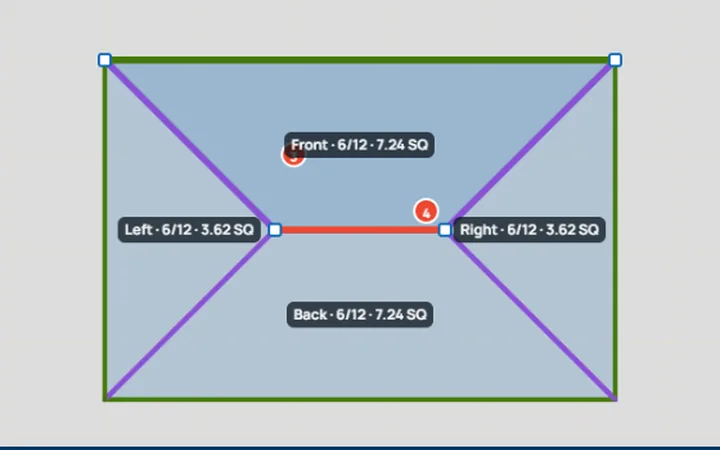
Every roof takeoff runs on two numbers per plane: how much ground it covers, and how steep it is. The pitch multiplier turns the first into real surface area. This post gives you the full chart from 1/12 to 12/12, the hip and valley factors, and the math, so you never have to trust a chart you can't check. It's the same math ROI Airstrike runs on every plane you trace.
Where the multiplier comes from
Pitch is rise over run: a 7/12 roof climbs 7 inches for every 12 inches across. Picture one foot of level run. The roof surface above it is the long side of a right triangle, so its length is the square root of 1 + (rise ÷ 12)².
Pitch multiplier = √(1 + (rise ÷ 12)²)
That's all a pitch chart is. You can check any line in the chart below with a phone calculator.
The chart: multiplier, hip and valley factor, angle
Each line reads: pitch · pitch multiplier · hip and valley factor · angle in degrees.
- 1/12 · 1.003 · 1.417 · 4.8°
- 2/12 · 1.014 · 1.424 · 9.5°
- 3/12 · 1.031 · 1.436 · 14.0°
- 4/12 · 1.054 · 1.453 · 18.4°
- 5/12 · 1.083 · 1.474 · 22.6°
- 6/12 · 1.118 · 1.500 · 26.6°
- 7/12 · 1.158 · 1.530 · 30.3°
- 8/12 · 1.202 · 1.563 · 33.7°
- 9/12 · 1.250 · 1.601 · 36.9°
- 10/12 · 1.302 · 1.641 · 39.8°
- 11/12 · 1.357 · 1.685 · 42.5°
- 12/12 · 1.414 · 1.732 · 45.0°
Using the multiplier: area and squares
Surface area = footprint area × pitch multiplier.
Worked example: a plane traces at 1,800 square feet of footprint at 7/12. 1,800 × 1.158 = 2,084 square feet, or 20.8 squares (a square is 100 square feet). Do each plane on its own pitch, add them up, then add the waste you use for that roof.
Using it for rake length
The rake (the sloped edge of a gable) runs up the roof, so its length is its level run times the same multiplier.
Worked example: a gable with 15 feet of level run from eave to ridge at 6/12. 15 × 1.118 = 16.8 feet of rake on that side.
The hip and valley factor
A hip or valley runs diagonally across the plan, at 45° to the walls when the two planes meeting there have the same pitch. For each foot of common run, the hip covers √2 feet of plan, so its factor is the square root of 2 + (rise ÷ 12)².
Hip and valley factor = √(2 + (rise ÷ 12)²)
Worked example: a hip roof with 15 feet of common run at 6/12. 15 × 1.500 = 22.5 feet for each hip. Planes with different pitches meet at a different angle, so this shortcut doesn't apply to them; measure those hips directly.
Pitch to degrees
Some tools and manufacturer specs use degrees. The angle is the arctangent of rise ÷ 12: 4/12 is 18.4°, 6/12 is 26.6°, 12/12 is 45°.
Where the pitch comes from
None of this works with a guessed pitch. A photo taken straight down shows the footprint, not the slope, so the pitch has to come from a gauge on site, the attic, the plans or a past invoice. ROI Airstrike asks you to enter the pitch for each plane. It then works out true area, rake, hip and valley lengths from your numbers and carries them into an estimate from your own price book, with every number traced.
For the photo side of a takeoff, see how to measure a roof from aerial photos.
Price: $120 for a 30-day key or $1,200 for a year, one payment, no automatic renewal, one key for every user and device at your business. The 7-day demo is free in your browser.