Roofers · ROI Airstrike
How to measure a roof from aerial photos (and check the math)
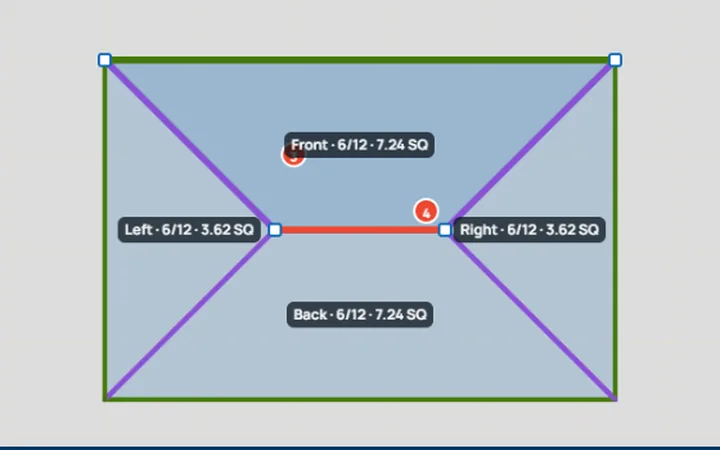
You can bid most roofs without climbing a ladder first. An aerial photo gives you the outline of every roof plane; the pitch turns that flat outline into real surface area. This post walks through the math by hand, so you can check whatever tool you use, including ours, ROI Airstrike.
Step 1: Trace each plane's outline on the photo
From above, a roof plane looks flat. What you trace is its footprint: the area it covers on the ground plan. Trace each plane separately (a simple gable is two planes, a hip roof is four or more), because each one can have its own pitch.
Three things trip people up on photos:
- Overhangs. Trace the drip edge, not the wall line. The photo shows the roof edge; the wall is hidden under it.
- Trees and shadows. If a tree hides a corner, finish the line where the roof clearly goes, then confirm it on site.
- Photo lean. Tall buildings can lean in aerial photos. Most houses are low enough that this is small, but it's another reason to check one known measurement on site.
Step 2: Get the pitch for each plane
Pitch is rise over run: a 6/12 roof rises 6 inches for every 12 inches across. A photo taken straight down can't show pitch, so it has to come from somewhere real: a pitch gauge on site, a reading from the attic, the plans, or the customer's last roofing invoice.
That's why ROI Airstrike asks you to enter the pitch for each plane instead of guessing it from the photo. The app then works out true area, rake, hip and valley lengths from your numbers.
Step 3: Multiply the footprint by the pitch factor
Surface area = footprint area × pitch multiplier. The multiplier is the square root of 1 + (rise ÷ 12)².
- 3/12: 1.031
- 4/12: 1.054
- 5/12: 1.083
- 6/12: 1.118
- 7/12: 1.158
- 8/12: 1.202
- 9/12: 1.250
- 10/12: 1.302
- 12/12: 1.414
Worked example. One plane traces at 1,200 square feet of footprint, and the pitch is 6/12. Surface area = 1,200 × 1.118 = 1,341.6 square feet.
Step 4: Convert to squares and add your waste
A roofing square is 100 square feet, so 1,341.6 square feet is 13.4 squares. Add each plane up the same way, then add the waste factor you use for that roof style and material. Waste is your call; it belongs in your price book, not in somebody else's default.
Step 5: Check your tool against something you already know
Before you trust any measuring tool, measure something with a known size. A baseball infield is a good one: the bases are 90 feet apart, so the square inside them is 90 × 90 = 8,100 square feet. Trace it, and see what the tool says.
We did exactly that with ROI Airstrike on University of Central Arkansas fields here in Conway. It's in the ROI Airstrike presentation, with the screens.
Where an app saves the time
Doing this by hand is fine for one roof. Doing it for every bid is where the morning goes. ROI Airstrike does the outline on free 1-ft aerial photos, keeps a property photo offline, applies your pitch to each plane, and carries the measurements straight into an estimate from your own price book, with every number traced so you can show your work.
It's one app for the whole job: measure, estimate, signed Good / Better / Best proposal, then the build board to paid. It works offline once it's open.
Price: $120 for a 30-day key or $1,200 for a year, one payment, no automatic renewal. One key covers every user and device at your business. Try the 7-day demo free in your browser first.